
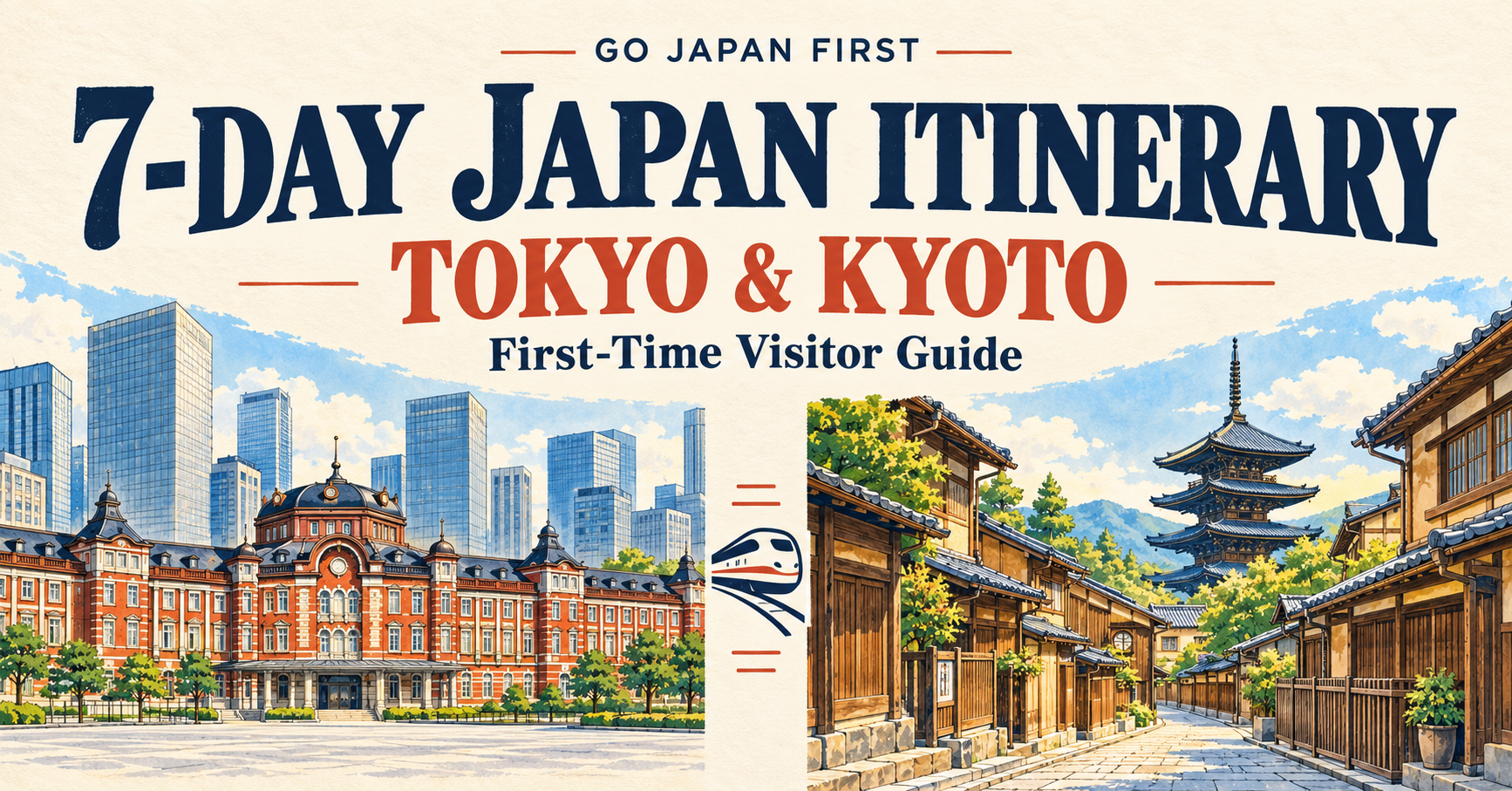
For a first trip with seven days in Japan, Tokyo and Kyoto give you two contrasting bases: big-city neighborhoods in Tokyo and temple districts, historic streets, and riverside scenery in Kyoto. The difficult part is fitting them around your flights without turning every day into a transfer.
This suggested route uses six hotel nights: three in Tokyo and three in Kyoto. It assumes you arrive in Tokyo on Day 1 and depart from Kansai International Airport on Day 7. If your return flight leaves Tokyo, use the adjustment below instead.
Planning note: Official destination and rail information was checked on October 6, 2026. The daily sequence and suggested buffers are our editorial planning choices, rather than a report of a personal trip. Check opening days, ticket availability, and transport details for your travel dates.
7-Day Japan Itinerary at a Glance
Our suggested split: settle into Tokyo on Day 1, explore Tokyo on Days 2 and 3, travel to Kyoto on Day 4, explore Kyoto on Days 5 and 6, and reserve Day 7 for departure. Choose one hotel in each city so you can unpack and avoid repeated check-ins.
| Day | Main plan | Sleep that night |
|---|---|---|
| Day 1 | Arrive in Tokyo; keep the evening near your hotel | Tokyo |
| Day 2 | Asakusa and Ueno | Tokyo |
| Day 3 | Meiji Jingu, Harajuku, and Shibuya | Tokyo |
| Day 4 | Travel to Kyoto; a flexible afternoon near your base | Kyoto |
| Day 5 | Kiyomizu-dera, Higashiyama, Yasaka-jinja, and Gion | Kyoto |
| Day 6 | Choose Arashiyama or Fushimi Inari | Kyoto |
| Day 7 | Transfer to Kansai International Airport and depart | No hotel night included |
Count your days in Japan, not just your days off work. This plan includes arrival and departure days. International flight dates and time-zone changes may mean you need additional calendar days away from home.
Check Your Flights Before Booking Hotels
Compare a multi-city flight search with arrival in Tokyo and departure from Kansai International Airport, near Osaka. This can remove the need to travel back to Tokyo, but compare the actual airfare, baggage allowance, and flight times. A multi-city ticket is a route option, not a guarantee of a lower price.
If you arrive late on Day 1 or leave early on Day 7, you still have five middle days for sightseeing and the intercity transfer. Treat the schedule as a compact introduction. If you want more unplanned time, reduce the number of districts or spend the whole week in one region.
Where to Stay for This Route
Tokyo: book Nights 1, 2, and 3. Choose your base after checking the airport-to-hotel journey and the connection for your Kyoto train. Read our Tokyo hotel-area guide for first-time visitors to compare Shinjuku, Shibuya, Ginza, Ueno, Asakusa, and the Tokyo Station area.
Considering Shinjuku or Shibuya for your Tokyo stay? Read our Shinjuku vs Shibuya hotel-area comparison to compare station access, hotel locations, room value, and evenings before booking.
Kyoto: book Nights 4, 5, and 6. Compare your arrival and departure needs with your sightseeing plans. Our Kyoto hotel-area guide for first-time visitors covers Kyoto Station, downtown options, Gion and southern Higashiyama, Karasuma Oike and Nijo Castle, and Arashiyama.
For either city, map the actual property rather than relying on its neighborhood label. Check the closest station entrance, the walk with luggage, room occupancy, check-in time, and cancellation terms. Before your room is ready, ask whether your hotel can hold your bags; do not assume every property offers the same service.
Affiliate disclosure: We may earn a commission if you book through the Expedia links below. Read our full affiliate disclosure.
Compare hotels for your Tokyo and Kyoto nights
Enter your dates and guest count, then check the property’s location, total price, room details, and cancellation terms.
Your Day-by-Day Tokyo and Kyoto Plan
Day 1: Arrive in Tokyo and Settle In
Make your hotel the main destination. Finish airport formalities, travel into the city, and check in or use a confirmed luggage-storage arrangement. A flight landing time is not the time you will reach your room.
If you still have energy, take a short walk near your hotel, find dinner, and learn the route to your nearest station. Leave a major attraction for tomorrow. A relaxed first evening is easier to adapt if immigration, baggage collection, or your airport transfer takes longer than expected.
Tonight: Tokyo, Night 1 of 3.
Day 2: Explore Asakusa and Ueno
Start with Asakusa: Kaminarimon, Nakamise Shopping Street, and the Sensoji temple precinct form a useful first sightseeing cluster. Give yourself time for the streets around the temple instead of treating the visit as a single photo stop.
After lunch, continue to Ueno. Choose between a walk in Ueno Park, one museum that interests you, or browsing around Ameyoko. Check the museum’s own opening calendar before making it the day’s fixed anchor. You do not need to fit all three into the afternoon.
Choose your connection on a current map. Walking between districts adds distance to a day that already includes sightseeing on foot; taking a train or taxi is an alternative. Return to your hotel area for dinner if you are tired.
Tonight: Tokyo, Night 2 of 3.
Day 3: Meiji Jingu, Harajuku, and Shibuya
Use today for western Tokyo. Begin around Meiji Jingu and Harajuku, then choose the shopping streets or cafes that match your interests. Avoid committing the entire day to a list of shops before seeing how much walking you want to do.
Continue to Shibuya for the crossing, shopping, and dinner. If a ticketed observation deck or other attraction is important to you, check its official availability first and build the afternoon around that booking. Otherwise, keep the schedule flexible.
This is your final full Tokyo sightseeing day on the main route. Skip an extra district if it would turn the evening into a rush. Before bed, confirm tomorrow’s departure station, train reservation, luggage arrangements, and Kyoto hotel address.
Tonight: Tokyo, Night 3 of 3.
Day 4: Travel from Tokyo to Kyoto
Check out and take the Tokaido Shinkansen to Kyoto. Tokyo Station and Shinagawa Station are departure options; select the station on your ticket and plan the hotel-to-platform journey separately. Check the actual service and fare through Smart EX or another official JR booking channel.
Keep a substantial part of the day available for the transfer. Checkout, getting to the station, finding the platform, the train journey, and reaching your Kyoto hotel are separate tasks. Avoid a tight non-refundable sightseeing reservation immediately after your expected arrival.
Once your bags are stored or your room is ready, take an easy walk near your chosen base. Downtown shopping or a riverside stroll can work if your arrival time and hotel location allow it. If you want to visit a particular shop, check its hours rather than assuming it will be open in the evening.
Tonight: Kyoto, Night 1 of 3.
Day 5: Kiyomizu-dera, Higashiyama, and Gion
Make eastern Kyoto today’s focus. Begin at Kiyomizu-dera, then continue through the Sannenzaka and Ninenzaka streets toward Yasaka-jinja and Gion. Kyoto’s official Higashiyama walking route is a useful starting point for planning this sequence.
An early start is an option if it fits your energy and transport arrangements. Check current temple visiting hours and admission details, and allow for sloping streets, steps, weather, and breaks. Seeing fewer places comfortably is a valid version of this day.
Keep to public routes, follow posted photography instructions, and avoid blocking residential streets. Later, choose dinner near Gion, downtown, or your hotel according to how much walking you want to add.
Tonight: Kyoto, Night 2 of 3.
Day 6: Choose Arashiyama or Fushimi Inari
Choose one main outing today. These options suit different interests, and making a choice leaves space for lunch, weather changes, and preparing for departure.
Option A: Arashiyama. Consider this for the bamboo grove, the Togetsu-kyo Bridge area, and a temple or garden visit. From Kyoto Station, the JR Sagano Line serves Saga-Arashiyama Station. Check Kyoto’s official Arashiyama access guide; the JR, Randen, and Hankyu stations are different places.
Option B: Fushimi Inari. Consider this if the shrine and its torii-lined paths are a priority. Decide how far uphill you want to go rather than assuming that a short visit and a mountain walk are the same plan. The shrine’s official access page distinguishes JR Inari Station from Keihan Fushimi-inari Station.
Use the remaining time for a missed stop near your base, shopping, or an early dinner. Confirm your airport transfer and pack tonight. If you are flying home from Tokyo, replace much of this day with the return journey described below.
Tonight: Kyoto, Night 3 of 3, on the Kansai-departure route.
Day 7: Depart from Kansai International Airport
Make departure the main task. Kansai International Airport is not in Kyoto city. JR-WEST’s HARUKA service connects Kyoto with Kansai-airport; check the official airport rail guide and current timetable for your flight.
Work backward from your airline’s required airport arrival time. Include the hotel-to-station journey, airport transfer, correct terminal, and a buffer. An early flight may call for a different final-night location. Add sightseeing only after you have a realistic departure plan.
Tonight: no Japan hotel night is included in this seven-day, six-night plan.
How to Adapt the Route to Your Flights
If You Arrive and Depart Through Tokyo
Keep Tokyo on Days 1 to 3 and travel to Kyoto on Day 4. Explore eastern Kyoto on Day 5, then return to Tokyo on Day 6 and sleep there before your Day 7 flight. This gives you three Tokyo nights, two Kyoto nights, and one final Tokyo night.
The return journey replaces part or all of the main route’s Day 6 outing. Our suggested buffer is to be back in the departure region the day before an international flight, rather than building the plan around a tight Kyoto-to-Tokyo-to-airport connection on departure day.
If You Start in Kansai and Finish in Tokyo
Reverse the order of the two cities and their sightseeing blocks, while keeping arrival and departure days light. Check your actual flight times before assigning nights. A reversed route does not automatically have the same useful sightseeing hours.
Transport, Luggage, and Rail Pass Decisions
Reserve around your real plans. Compare the actual train service, seat type, fare conditions, and station access. Local trains and airport transfers need their own planning; a Shinkansen reservation is only one part of the journey.
Measure your suitcase before selecting a seat. For the ordinary Tokaido Shinkansen arrangements covered by JR Central’s luggage guide, baggage with total length, width, and height over 160 cm and up to 250 cm requires an appropriate oversized-baggage seat reservation. The general rule does not mean every suitcase needs that reservation; check the official guidance for your luggage and service.
Price a rail pass rather than buying one by default. This main route has one Tokyo-to-Kyoto journey; returning to Tokyo adds a second. Compare your intended individual journeys with the current JAPAN RAIL PASS prices and coverage. Pass holders using Nozomi also need the separate applicable ticket described in the official Nozomi and Mizuho conditions.
What to Book Before You Arrive
- Flights: confirm the arrival city, departure airport, dates in Japan, and baggage allowance before assigning hotel nights.
- Hotels: book the correct six nights, guest count, and room type; review cancellation terms and any taxes payable separately.
- Intercity travel: choose the actual train and departure station, and arrange the right seat for your luggage.
- Priority attractions: check official opening calendars and reserve any ticketed experience you would be disappointed to miss.
- Airport transfers: check the service times and terminal arrangements for both arrival and departure.
- Arrival essentials: arrange a way to access maps and booking details, keep your hotel address handy, and decide how you will pay for local transport.
Frequently Asked Questions
Is Seven Days Enough for a First Japan Trip?
It can work for a focused introduction to Tokyo and Kyoto if you accept a compact schedule. With arrival, departure, and a transfer included, you do not have seven full sightseeing days. If you prefer slower mornings, extensive museum visits, or several day trips, add time or choose one region.
Should I Add Osaka, Nara, Hakone, or Mount Fuji?
We suggest using this week for the two-city route first. If another destination is your main reason for traveling, replace an existing sightseeing day or redesign the route around it. Adding destinations also adds transport and reduces the time already allocated to Tokyo and Kyoto.
Do I Need to Change Hotels Within Each City?
This plan uses one Tokyo hotel and one Kyoto hotel to reduce packing and check-in tasks. Choose the property around your airport journey, sightseeing priorities, and intercity connection. The Tokyo round-trip variant adds a final Tokyo stay, so reserve that night separately.
Can I Follow This Plan With Children or Limited Walking?
Use the district groupings, but shorten each day to one main activity and one optional stop. Check the accessibility of the actual attraction, station entrances, and hotel. The eastern Kyoto walking day and any uphill shrine walk deserve particular attention when adapting the plan.
What If I Have Seven Full Sightseeing Days?
Then your trip is longer than this seven-calendar-day model if you also need separate arrival and departure days. Keep the same two bases and use the additional time for a slower Tokyo day, another Kyoto district, or a chosen day trip after checking its transport requirements.
Official Planning Sources
Use these primary sources to check details for your dates. The seven-day route and hotel-night allocation above are our suggested planning framework.
- GO TOKYO: exploring Asakusa
- GO TOKYO: exploring Ueno
- GO TOKYO: neighborhood itinerary ideas
- GO TOKYO: Shibuya
- Kyoto Travel: Higashiyama walking route
- Kyoto Travel: Saga and Arashiyama
- Kyoto Travel: Arashiyama access
- Fushimi Inari Taisha: access
- Smart EX: Shinkansen reservations
- JR Central: luggage information
- JR-WEST: Kansai airport rail guide
- JAPAN RAIL PASS: current prices
- JAPAN RAIL PASS: Nozomi and Mizuho conditions
Your next step: confirm the two ends of your flight itinerary, assign the hotel nights, and compare the Tokyo and Kyoto hotel areas before filling the days with attraction bookings.

Comments