
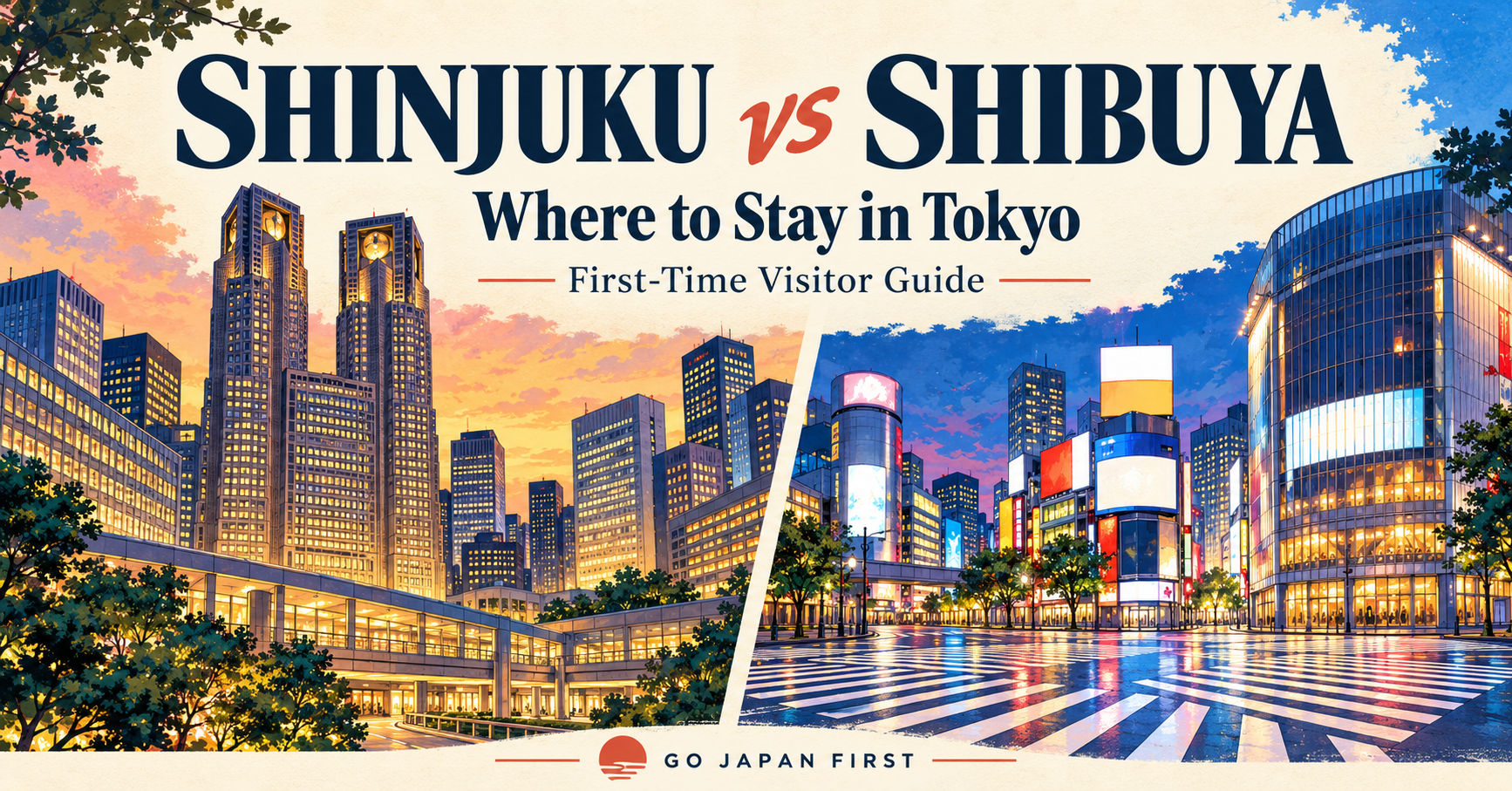
Shinjuku or Shibuya for your first stay in Tokyo? Both can work well. The useful question is which one makes your actual trip easier: your arrival with luggage, the places you plan to visit, and the evenings you want to spend near your hotel.
Our planning recommendation: start with Shinjuku if your itinerary includes departures from its rail or bus terminals and you want a broad choice of evening activities. Start with Shibuya if shopping, cafes, and time around Shibuya, Harajuku, and Omotesando shape your visit. Then compare specific hotels before deciding.
If you are still choosing among Tokyo neighborhoods, read our guide to six Tokyo hotel areas for first-time visitors. This comparison is for travelers who have narrowed their shortlist to Shinjuku and Shibuya.
Affiliate disclosure: This article contains affiliate links. If you book through one, we may earn a commission at no extra cost to you. Read our affiliate disclosure.
Shinjuku vs Shibuya at a Glance
| Priority | Shinjuku | Shibuya |
|---|---|---|
| Main appeal | A flexible base when Shinjuku departures and evenings are part of your plan. | A base for a trip focused on Shibuya and nearby shopping and cafe areas. |
| Hotel location | Compare the west, south, and east sides rather than treating the district as one place. | Check which side of the station your hotel occupies and its walking route. |
| Narita arrival | Direct Narita Express services are available; check your particular train. | Direct Narita Express services are available; check your particular train. |
| Luggage | Identify your operator, station entrance, and hotel entrance in advance. | Identify your operator, station entrance, and hotel entrance in advance. |
| Price and room value | Compare the total for your dates and exact room type. | Compare the total for your dates and exact room type. |
| Light sleepers | Check the property’s street, room orientation, and recent noise reviews. | Check the property’s street, room orientation, and recent noise reviews. |
On a narrow screen, swipe the table sideways to see all columns. The recommendations above are editorial judgments, not rankings of individual hotels.
How to Choose Between Them
Write down your arrival airport, one or two fixed bookings, and the places you expect to spend your evenings. A hotel that makes those plans easy is more useful than a neighborhood that wins a generic popularity contest.
- Lean toward Shinjuku when a booked rail journey, bus departure, or tour meeting point is there and you want a manageable morning route.
- Lean toward Shibuya when you expect repeated time in its shopping and cafe areas and want to return to your hotel between activities.
- Let the better hotel decide when your sightseeing is spread across Tokyo. Give room layout, sleep, cancellation terms, and the actual entrance-to-entrance walk priority.
These are starting points. Do not pay more for a district name without checking what it improves for your own schedule. Compare one realistic hotel in each area rather than an idealized version of one neighborhood against an inconvenient property in the other.
Getting Around and Arriving With Luggage
Travel between Shinjuku and Shibuya
The JR Yamanote Line connects the two stations directly, as shown in GO TOKYO’s Shibuya guide. You can visit the other district without changing hotels. Station navigation and the walk to your room still add time beyond the train ride.
For a first visit, save the hotel address and its official access instructions before departure. Identify the railway company you will use, the relevant entrance or exit, and an elevator route if needed. A pin placed near a station on a booking map does not show the full journey from your platform.
Arriving at Narita Airport
JR East’s Narita Express serves both Shibuya and Shinjuku on its Shinjuku-bound route. Check the destination, stopping pattern, departure time, and ticket requirements for the service you intend to take. Direct service availability does not mean every Narita Express train goes to both stations.
For a late arrival, compare your realistic departure time from the airport with the available services. Include immigration, baggage collection, and the final hotel walk. Ask the hotel about late check-in instead of assuming that a scheduled landing time is your arrival time at reception.
Arriving at Haneda Airport
Haneda Airport’s official rail guide lists the Keikyu Line and Tokyo Monorail. Use your actual terminal, travel time, and hotel address to compare routes onward to Shinjuku or Shibuya. Check transfers and elevator access as well as the headline journey duration.
Airport access alone should not decide the neighborhood unless your arrival or departure creates a specific constraint. A slightly different train journey may matter less than an awkward walk with luggage, or a hotel that cannot accept your arrival time.
Where to Look Within Shinjuku
Shinjuku’s sides have different surroundings. GO TOKYO’s district guide places the skyscraper area west of the station, shopping and entertainment to the east, and the expressway bus terminal to the south. Use those broad distinctions to begin a hotel search, then inspect the individual address.
West and south of the station
Consider a hotel on the west or south side when its access route matches your arrival or a fixed morning departure. Check the actual walk rather than assuming every west-side or south-side property is close to the entrance you need.
The Shinjuku Expressway Bus Terminal has its own official access information. If you have a bus booking, verify the terminal, departure floor, and boarding point. A guided tour described as departing from Shinjuku may use a separate meeting location.
East side and the Kabukicho area
An east-side address can suit travelers who value evenings around local dining and entertainment. For a quieter room, compare the immediate street, nearby venues, and recent guest comments. Ask whether a room faces a busy road or nightlife street and whether a different orientation is available.
Do not assume every hotel in this area shares the same atmosphere. A good room on a suitable street can matter more than a broad district label. Conversely, a highly rated property can still be a poor match for a light sleeper if the reviews describe late-night noise.
Where to Look Within Shibuya
Shibuya’s crossing, fashion, shopping, and cafe culture are central to its appeal, according to GO TOKYO’s area guide. Staying here can be useful when those activities are a recurring part of your visit, rather than a single stop on a wider itinerary.
Choose the hotel walk, not just the crossing
Decide whether you want to be close to the activities you will repeat or prefer a property farther from the busiest streets. Check the route from the railway entrance you will actually use. The most convenient hotel for one line may not be the most convenient for another.
Look for stairs, slopes, major crossings, and the location of the reception entrance along that route. These are property-specific checks: use the hotel’s access page and map rather than assuming all accommodation around Shibuya offers the same walk.
If Shibuya sounds like the better fit, the next step is choosing the right room. Our Shibuya Station hotel comparison covers six options, with official access routes, example room sizes and booking checks.
Planning Harajuku and Meiji Jingu visits
If your plans include Meiji Jingu, check the shrine’s official access information. Its southern entrance is associated with the Harajuku and Meiji-jingumae approach; your hotel’s Shibuya address alone does not tell you how you will reach the entrance you want.
Use the same approach for shopping and cafes: group the places you want to visit, then check whether your hotel helps you move between them. A neighborhood name is a useful search filter, but an exact address is what determines your daily walk.
Match Your Hotel Base to the Rest of Your Trip
Hakone or a departure from Shinjuku
Odakyu’s Romancecar offers services between Shinjuku and Hakone-Yumoto. The operator explains that you need the regular fare and a limited express ticket. If this is your chosen journey, a suitable Shinjuku hotel may simplify the start of the day.
That advantage depends on the actual departure you book. Confirm the service and meeting point before using them as the reason to choose a hotel. Do not assume every Hakone route, Mount Fuji trip, or organized tour starts from the same station or terminal.
A week split between Tokyo and Kyoto
Either area can be your Tokyo base for our 7-day Japan itinerary covering Tokyo and Kyoto. The route is designed around hotel nights and arrival and departure airports, so choose your dates first and your neighborhood second.
If you are continuing to Kyoto, use our Kyoto hotel-area comparison to plan that stay separately. Moving between Shinjuku and Shibuya during a short Tokyo stay adds another packing, checkout, and check-in cycle; choose one base unless a specific booking makes the move worthwhile.
A trip focused elsewhere in Tokyo
If most of your fixed plans sit outside these districts, return to the six-area Tokyo guide and compare other bases. You can visit Shinjuku and Shibuya while staying elsewhere. Being close to one evening highlight is less useful if it repeatedly complicates the rest of your itinerary.
What to Check Before Booking
Shortlist one hotel in each area, then compare them on equal terms. Use the same dates, number of guests, bed requirements, meal inclusions, and cancellation flexibility. The cheapest headline room may be a different product from the room your party needs.
- Final price: compare the complete stay total, the booking currency, taxes and fees shown, and the payment conditions.
- Room layout: check floor area, bed sizes, bathroom arrangements, and space for your luggage.
- Occupancy: enter every guest, including children, and verify the property’s age and bed-sharing rules.
- Arrival: confirm reception hours, late check-in arrangements, and whether luggage storage is available for your dates.
- Walking route: check the actual station entrance, hotel entrance, and any stairs or slopes that affect your party.
- Sleep: read recent comments about noise and ask about room orientation when it matters.
- Cancellation: record the deadline, its time zone, and the charge that applies afterward.
If the two hotels cost a similar amount, choose the one that removes a specific inconvenience from your trip. A better bed arrangement or easier luggage route is a clearer benefit than paying for an area simply because its name is familiar.
Ready to compare your hotel shortlist?
Open the Tokyo hotel search, enter your dates and guests, and use the map to compare Shinjuku and Shibuya properties. The link opens a citywide search; check each hotel’s exact address and room terms.
Compare Tokyo hotels on Expedia
Affiliate link: we may earn a commission if you book, at no extra cost to you.
Frequently Asked Questions
Is Shinjuku or Shibuya better for a first visit?
Choose according to your itinerary and the specific hotels available. Our starting recommendation is Shinjuku for a trip shaped by its departures and evening options, and Shibuya for repeated shopping and cafe time around that district. Either can work for a broader Tokyo visit.
Which area is cheaper?
There is no dependable winner for every date and room type. Compare the same dates and guest requirements, then examine the total price, room size, bed arrangement, and cancellation terms. A lower nightly figure alone is not a useful comparison.
Should I split my stay between both areas?
Usually, one hotel is the simpler starting plan for a short stay. You can travel between the districts without moving your luggage. Split the stay only when a specific experience, reservation, or travel constraint gives the move a clear purpose.
Which is better for families or light sleepers?
Compare properties rather than choosing solely by district. For families, prioritize suitable beds, occupancy rules, an accessible walking route, and enough room for luggage. For light sleepers, use recent noise reviews and ask about the particular room’s location.
Do I need to stay near the busiest nightlife or shopping streets?
Only if that location helps your plans and suits your sleep preferences. Being able to visit a lively area does not require choosing a room on its busiest street. Check how you will return to the hotel after your planned evening.
Official Planning Sources
Destination and transport information was checked on October 6, 2026. The hotel-selection advice is our editorial interpretation of that information; it is not a review based on personal stays. Recheck operator schedules and property terms before booking.
- GO TOKYO: Shinjuku area guide
- GO TOKYO: Shibuya area guide
- JR East: Narita Express services
- Haneda Airport: train and monorail access
- Shinjuku Expressway Bus Terminal
- Odakyu: Romancecar to Hakone
- Meiji Jingu: visiting and access information
Next, fit your Tokyo base into the 7-day Tokyo and Kyoto route, or compare the wider options in our Tokyo hotel-area guide.








Comments